

Summer Exterior Maintenance for Calgary Homes: Hail, UV & Storm Prep
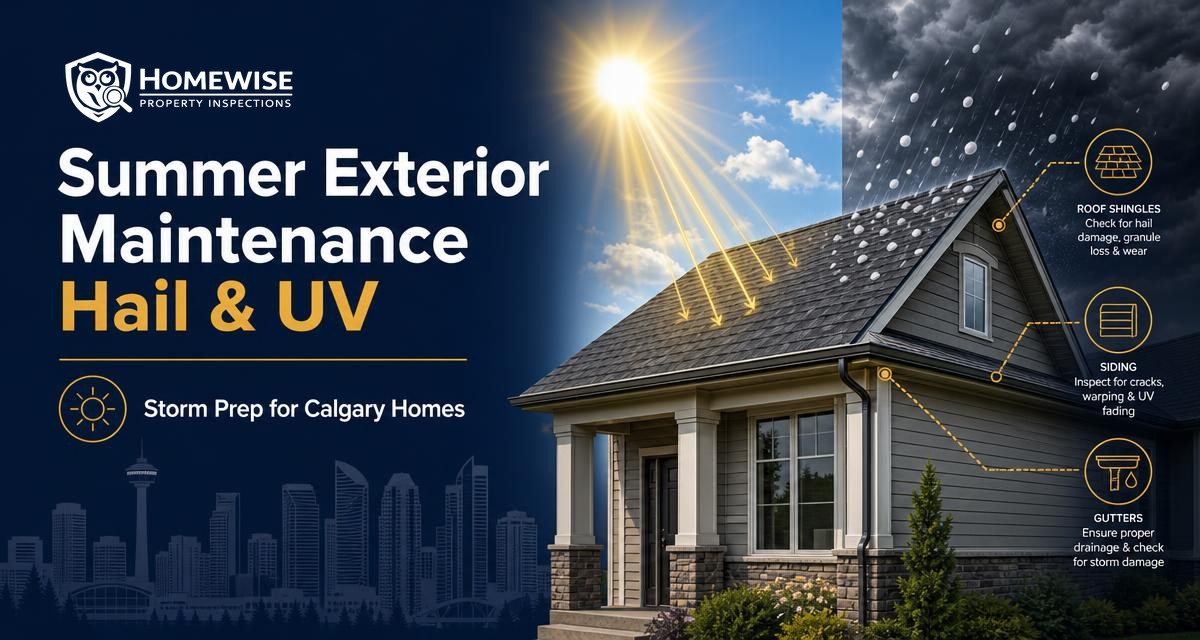
Calgary spring maintenance is about recovering from winter. Summer maintenance is about getting ahead of the next set of threats: hail, UV degradation, severe thunderstorms, and wildfire smoke. We sit in the heart of Canada's "hailstorm alley" — the Calgary–Red Deer corridor has the highest hail damage costs in the country, year after year.
Here's what to focus on between June and September.
1. Roof — the single biggest hail target
- Walk the perimeter after every significant hailstorm. Look up from each side for shiny bruise marks, missing granule patches, or exposed asphalt mat.
- Check the bottom of downspouts for sudden granule dumps — a strong indicator of hail impact even if the roof looks fine from the ground.
- If you suspect damage, get a documented inspection within days. Most insurers in Alberta require hail claims to be filed within a defined window after the event.
- Asphalt shingles in Calgary typically last 18–22 years instead of the rated 25–30 because of UV intensity at our 1,045 m elevation. Plan accordingly.
2. Siding & exterior trim
- Vinyl siding cracks and shatters from hail far more than it dents. Inspect the north and east sides after storms (hail typically drives from the southwest here).
- Check window screens — torn or pushed-in screens often signal a hail event even when the siding looks intact.
- Inspect painted trim and fascia for UV chalking. South- and west-facing elevations fade and crack 2–3× faster than north sides in Calgary.
3. Windows & seals
- Look for fogging or condensation between panes — a failed thermal seal. Summer heat accelerates seal failure, and you'll only see fogging during specific temperature/humidity conditions, so check on a few different days.
- Check exterior caulking around windows and doors. UV degrades silicone fastest; if a bead is cracked, peeling, or chalky, scrape it and re-caulk.
- Confirm window screens fit tightly — a primary defence against wasps and the increasingly common mosquito year.
4. Deck, fence & outdoor wood
- UV is the #1 killer of stained wood in Calgary. If water no longer beads on horizontal deck surfaces, you're due for a re-stain.
- Sand any grey, fuzzy patches before re-staining — they indicate UV degradation has reached the wood fibres.
- Check deck ledger flashing again mid-summer. Heavy thunderstorm rain finds defects that snowmelt didn't.
- Tighten any fence posts that show movement; dry summer soil shifts more than people expect, especially in clay-heavy neighbourhoods.
5. Grading, drainage & storm prep
- Walk the foundation during or right after a heavy rain. Watch where water actually goes — not where you think it goes. Pooling within 1 m of the foundation needs to be regraded.
- Confirm window wells drain. A clogged window well is the most common cause of summer basement flooding in Calgary.
- Test sump pumps before storm season. Pour a bucket of water into the pit and confirm it cycles. Consider a battery backup — Calgary's worst storms often knock out power.
- Re-attach any downspout extensions and confirm splash blocks are positioned correctly.
6. AC, HRV & exterior mechanicals
- Hose off the AC condenser coil monthly during cottonwood season — fluff clogs fins fast and tanks efficiency.
- Replace furnace/HRV filters more often during wildfire smoke events. A MERV 11–13 filter is a good compromise between filtration and airflow.
- Keep the AC unit shaded if possible, but don't enclose it — the manufacturer's clearance requirements still apply.
7. Wildfire smoke & air sealing
Smoke days are now a normal part of Calgary summers. The best mid-summer prep is honest air sealing:
- Inspect weatherstripping on exterior doors — same gaskets keep smoke out as keep winter air in.
- Confirm exhaust fan dampers in the bathroom and kitchen close fully when not in use.
- Run your HRV in recirculation mode (if equipped) during heavy smoke events.
8. Hail-storm-day routine
When the warning sirens go off, you have maybe 20 minutes:
- Pull vehicles into the garage or under cover.
- Close all windows, including basement windows.
- Move patio cushions, BBQ covers, and anything that can become a projectile.
- After the storm, photograph everything before cleanup — for insurance and for a possible inspection.
When to bring in a pro
Two scenarios where a professional eye pays for itself: (1) after a significant hailstorm where you suspect roof or siding damage but want documentation for insurance, and (2) before the end of warranty windows on a newer home — small summer-revealed issues are easier to claim while coverage is active. More on Alberta's new home warranty timelines.
Need a hand? Call (403) 710-7770 or book an inspection online.