

Radon Testing in Calgary: Do You Need It?
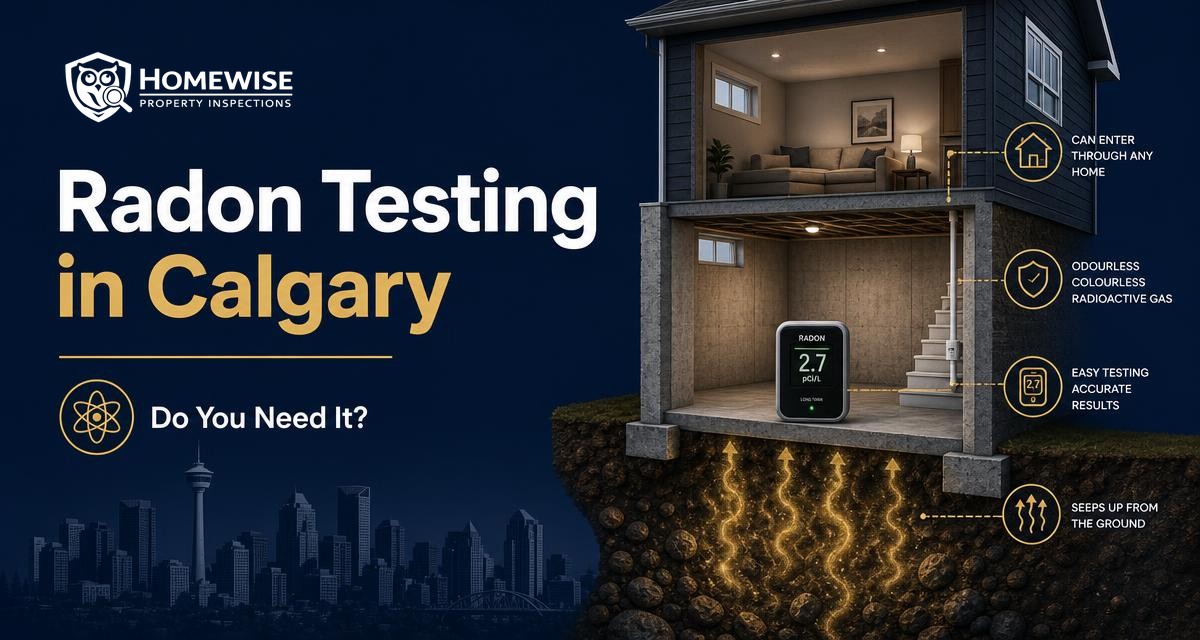
Calgary and surrounding areas — including Cochrane, Airdrie, and Okotoks — are in one of the highest-radon zones in Canada. Health Canada studies have repeatedly found that 1 in 5 Calgary homes exceeds the action level for radon. If you own a home here, you should test for radon. If you're buying, you should ask.
What is radon?
Radon is a naturally occurring radioactive gas released as uranium in the ground breaks down. It's invisible, odourless, and the second leading cause of lung cancer in Canada after smoking. It enters homes through foundation cracks, sump pits, and floor-wall joints, and concentrates in basements.
Why Calgary specifically
The geology beneath Calgary, the foothills, and southern Alberta produces above-average uranium content. Combined with our tightly sealed, energy-efficient newer homes, radon has nowhere to escape — concentrations build up year after year.
How testing works
- Long-term test (recommended): 91+ days using an alpha-track or digital monitor. This is what Health Canada considers the gold standard.
- Short-term test: 2–7 days, useful for real-estate transactions when you don't have months to wait.
- Action level in Canada: 200 Bq/m³. WHO recommends mitigation above 100 Bq/m³.
What if levels are high?
Mitigation typically costs $2,500–$3,500 for a sub-slab depressurization system installed by a C-NRPP certified contractor. It's effective: most systems reduce radon by 80–95%.
Should you test for radon?
If you're buying in Calgary, Cochrane, Airdrie, or Okotoks, yes — at minimum, plan to do a long-term test after possession. For a real-estate transaction with a short condition period, a short-term kit can run in the background while you decide.
HomeWise does not perform radon testing. We flag the things that make radon likely — sump pits, rough-in pipes, slab and joint details — and tell you what to arrange. Test devices come from radon measurement professionals and hardware suppliers, and mitigation work should be done by a C-NRPP certified contractor.
Questions about what your inspection does and doesn't cover? Call (403) 710-7770 or book your inspection.